

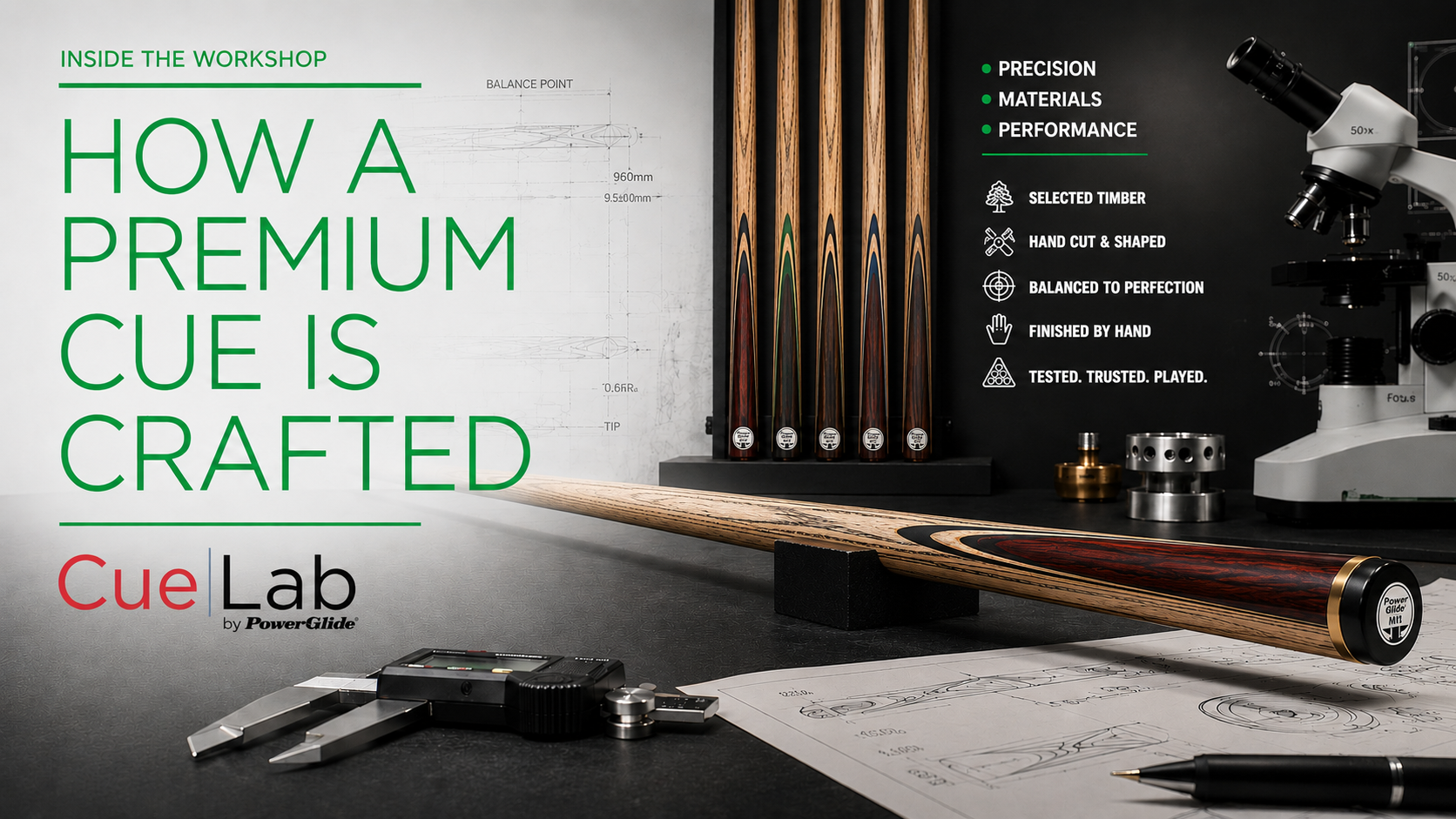
Cue|Lab Blog #1
August 2026
Read Time: 6 Minutes
Are all cues created equally?
Pick up two snooker cues of the same length, weight and timber, and they can still feel like completely different instruments. One responds, the other doesn’t. Players often assume price explains the gap, or brand, or simply luck. The truth sits somewhere less visible: in how the cue was made.
A premium cue isn’t stamped out in an afternoon. It’s the product of careful timber selection, slow seasoning and dozens of small decisions made by people who understand the game. In this article, we’ll take you inside the workshop to show how a premium cue is crafted, why each stage matters, and what separates genuine craftsmanship from mass production.
In this article, you'll learn
- Why timber selection sets the foundation for quality
- How seasoning and shaping shape performance
- What splicing and jointing really involve
- Why finishing is far more than appearance
- How to recognise authentic craftsmanship
01 It starts with great timber
Every premium cue begins as a plank. We select North American Ash for our shafts — it’s timber with straight, even grain and consistent density. Only a small fraction of any batch meets the standard. Grain matters because it carries feedback. Ash shows distinctive arrow-shaped chevrons — the tighter and straighter they run, the more predictable the cue behaves under load. A skilled maker reads each piece by eye and by hand, rejecting wood with knots, waves or uneven weight. This first decision quietly shapes everything that follows.
✔ Grain quality drives feedback
✔ Only select timber makes the cut
✔ The maker’s eye can’t be automated
02 Seasoning & Shaping
Good timber can’t be rushed. After selection, shafts are seasoned for months — sometimes years — so moisture leaves slowly, and the wood stabilises. Skip this stage and the cue risks warping later. Shaping happens in stages. The maker turns the shaft down gradually, resting it between passes so internal tension can settle rather than pulling the cue out of true. This patience is why a premium cue holds its straightness season after season, while a hurried one may drift within months of leaving the bench.
✔ Seasoning prevents warping
✔ Gradual tapering keeps cues true
✔ Patience builds long-term stability
Did you know?
A single premium cue can take many months to complete — and most of that time is spent simply waiting. The seasoning process, where timber slowly loses moisture, often takes longer than every other stage of manufacture combined.
03 The art of the splice
The butt is where craftsmanship becomes visible. Traditional cues use hand-cut splices, joining timbers in interlocking points rather than simply glueing veneers to the surface. A hand-spliced joint isn’t only decorative. It distributes weight through the lower section and influences balance, helping the cue feel connected from tip to butt. Cutting clean, symmetrical splices takes real skill. The tighter the join, the stronger and more stable the finished cue — which is why fine splicing signals genuine quality.
✔ Hand splicing signals authenticity
✔ Joints affect balance, not just looks
✔ Precision here defines quality
04 Finishing and final inspection
Finishing is often mistaken for cosmetics. In reality, the way a shaft is sanded and sealed affects how it feels in the hand and how smoothly it runs through the bridge. Makers apply finish in thin layers, burnishing between coats so the surface protects the timber without deadening the feedback players rely on. Before a premium cue is signed off, it’s checked for straightness, weight and balance. Only when it meets every standard does it earn its maker’s name.
✔ Finish affects feel, not just looks
✔ Thin layers preserve feedback
✔ Every cue is inspected before approval
MYTH V REALITY
MYTH Ash is only used because it's traditional
REALITY Ash is used because it consistently balances hardness and elasticity better than most alternatives
MYTH All ash shafts are essentially the same
REALITY Growing conditions and individual timber selection create real differences between shafts
MYTH Splices are purely decorative
REALITY Composites offer stability, but most players still prefer the feel and feedback of quality ash